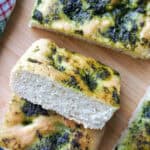
Wild Garlic Focaccia
Wild Garlic Focaccia, a lovely Spring twist on the classic Italian bread. A pillowy soft bread with a golden crust and the signature dimples, topped with a generous vibrant mixture of olive oil, wild garlic and a generous pinch of ground black pepper, what a treat this is! It's the perfect bread of Spring grazing, sharing or simply enjoying it dipped in olive oil.
Servings: 1 bread
Calories: 1829kcal
Ingredients
For the topping
- 25 g wild garlic (1 oz)
- 30 ml extra virgin olive oil (1 oz)
- 30 ml cold water (1 oz)
- ¼ teaspoon salt
- ¼ teaspoon ground black pepper
For the bread
- 350 g white strong bread flour (12 oz)
- 200 ml warm water (7 oz)
- 1 teaspoon salt
- 2 teaspoon dried fast-action yeast
- 2 tablespoon extra virgin olive oil
Instructions
- To make the topping, add all the ingredients to a blender or food processor, and blitz to a chunky texture.
- To make the bread, sift the flour in a large mixing bowl, add the yeast, salt, warm water and olive oil, and knead well until you get a smooth, slightly sticky dough that springs back - add more flour if necessary.
- Shape the dough into a ball, brush it with olive oil, cover the bowl with a kitchen towel, and prove in a warm place for 2 hours or until it doubles its size.
- Flour or oil a rectangle baking tray ( mine is 30 x 22 x 5 cm / 12 x 9 x 2 inches), and use your hands to gently stretch the dough to fit onto the baking tray.
- Prove it again for 30 minutes, then use a finger to poke several holes in the dough.
- Spread the wild garlic mixture over the top, and bake in the preheated oven at 220 degrees Celsius (430 Fahrenheit) for 20 minutes.
Video
Notes
- To achieve the best results, you must prove the dough in a warm place, not only it speeds up the proving time, but it also helps rise well enough for a light and airy bread.
- I usually turn the oven on on the lowest possible temperature for 5-10 minutes, switch it off, then prove the dough in there. Make sure the oven doesn't get too hot, as the dough will flatten rather than rise.
- If the dough proves in a cold place, you will have to wait for a long longer for it to double its size, and most of the times, the yeast simply doesn't activate. An underproof dough will be tough and flat.
- Make sure your yeast is still active, if you are unsure, add the warm water to a jug, add the yeast and a tablespoon of flour and one of sugar, give it a stir, and set it aside for 10-15 minutes - if the mixture is frothy, the yeast is good to use
- Then simply add the mixture to the sifted flour, add the oil and knead
Nutrition
Calories: 1829kcal | Carbohydrates: 268g | Protein: 47g | Fat: 62g | Saturated Fat: 9g | Polyunsaturated Fat: 8g | Monounsaturated Fat: 41g | Sodium: 2977mg | Potassium: 418mg | Fiber: 11g | Sugar: 1g | Vitamin A: 10IU | Vitamin C: 11mg | Calcium: 128mg | Iron: 4mg