How to Dye Easter Eggs with Red Cabbage
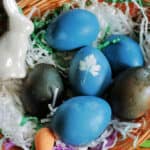
Learn how to dye Easter eggs naturally with red cabbage, chemical-free and totally foolproof. Despite its deep purple/red colour, red cabbage transforms eggs into beautiful shades of blue or green depending on the colour of the egg shells and dying conditions. It's fun, a great activity for Easter, and something that can entertain kids of all ages.
Servings: 6 eggs
Calories: 107kcal
Ingredients
- 4 white-shelled eggs
- 2 shelled eggs
- 1 red cabbage (700 g, 1.5 lb)
- 2 tablespoon vinegar
- 4 cups water (1 L)
- 1 teaspoon table salt
Instructions
- Rinse the eggs thoroughly under cold water, then boil them for at least 10 minutes until they are hard-boiled.
- Chop the cabbage roughly and add it to a separate pan.
- Cover it with water, add the salt, and simmer it for 20 minutes on a medium heat until the water has a deep purple colour.
- Remove the pan from the heat, strain the cabbage, and reserve the liquid.
- Stir in the vinegar, then carefully submerge the boiled eggs in the dye water.
- Leave the eggs in the water for at least 2 hours, for a pale blue colour for the white eggs, and a green colour for the brown eggs.
- The longer the eggs stay in the cabbage water, the deeper the colour, I left mine in for 6 hours.
Video
Notes
- Do not rush the dying process, for deeper colours it's always best to leave the eggs in overnight, it might not look like much at first, but you'll be surprised how well the colour sticks to the egg shells.
- Vinegar is a crucial ingredient in dying eggs, it helps the colour stick better and get a deeper, more vibrant hue.
- Don't overcrowd the eggs, they need to be fully submerged in the dye water for an even, deep colour. You can even create patterns by sticking leaves onto the eggs and wrapping them in a cheesecloth or old tights that are cut just long enough to wrap the eggs in.
- Always ensure the eggs are hard boiled before adding them to the dye water, soft-boiled eggs will be hard to peel afterwards.
- The liquid is enough to dye a lot more eggs, I only did a small batch of 6, but you can definitely dye a lot more than that.
Nutrition
Calories: 107kcal | Carbohydrates: 11g | Protein: 8g | Fat: 4g | Saturated Fat: 1g | Polyunsaturated Fat: 1g | Monounsaturated Fat: 2g | Trans Fat: 0.02g | Cholesterol: 164mg | Sodium: 502mg | Potassium: 401mg | Fiber: 3g | Sugar: 6g | Vitamin A: 1798IU | Vitamin C: 80mg | Calcium: 93mg | Iron: 2mg